
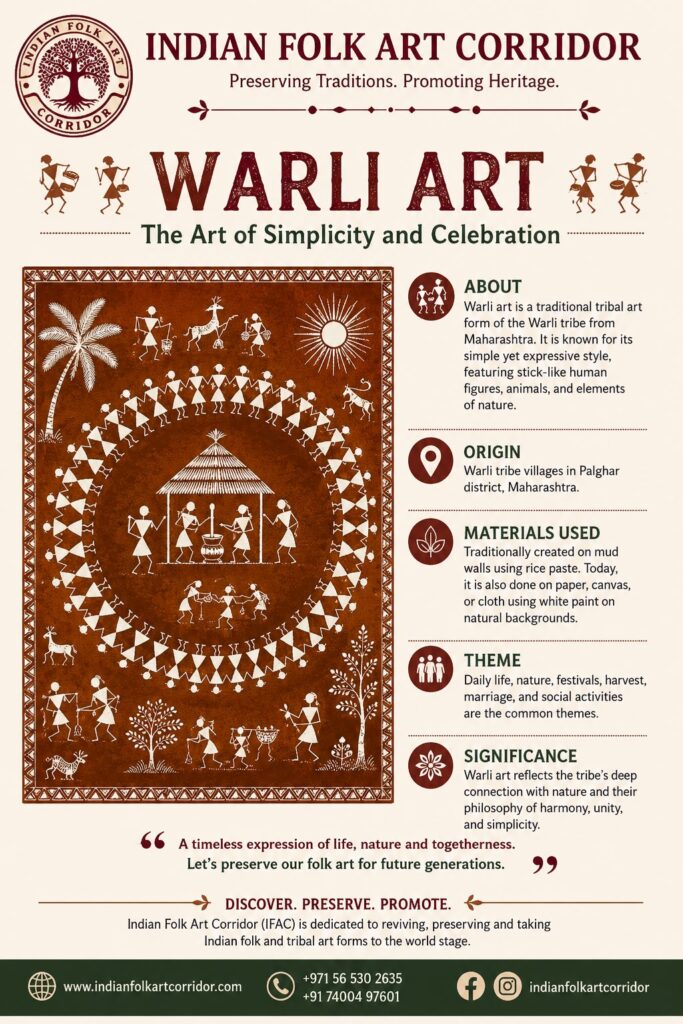
At Indian Folk Art Corridor by Vidisha Pandey (IFAC), we are dedicated to preserving and promoting India’s rich folk and tribal art heritage. Through our educational initiatives, we aim to celebrate traditional art forms and create greater awareness about the skilled artisans who continue to keep these remarkable traditions alive.
Among India’s most treasured indigenous art forms is Warli Art, a centuries-old tribal painting tradition that beautifully captures the relationship between people, nature, and community.
The History of Warli Art
Warli Art originated among the Warli tribe residing in the regions of Palghar, Thane, Nashik, and Dahanu in Maharashtra. Believed to be over 2,500 to 3,000 years old, this ancient art form is recognized for its simplicity, symbolism, and storytelling.
For generations, the Warli people have lived in close harmony with nature, and their paintings reflect this deep connection. Traditionally, Warli paintings adorned the mud walls of village homes during weddings, harvest festivals, religious ceremonies, and other important community celebrations. More than decorative artworks, these paintings were believed to bring prosperity, fertility, happiness, and harmony to the household.
Unique Features of Warli Art
What makes Warli Art instantly recognizable is its minimalistic style and meaningful symbolism.
Traditionally, artists paint using a white pigment prepared from rice flour, water, and natural gum on an ochre, red, or mud-brown background. The striking contrast creates elegant compositions using only a few simple elements.
The visual language of Warli Art is built around basic geometric shapes, each carrying symbolic meaning:
- Circle represents the Sun and the Moon, symbolizing the rhythm of life.
- Triangle represents mountains, trees, and the energy of nature.
- Square symbolizes sacred spaces, rituals, and divine power.
- Human and animal figures are formed using two connected triangles, representing balance, stability, and harmony between humans and nature.
Despite its simplicity, every element contributes to a larger narrative that reflects everyday life and spiritual beliefs.
Themes That Tell Stories
Warli Art is often described as a visual diary of tribal life. Each painting narrates stories inspired by the community’s daily experiences, celebrations, and relationship with nature.
Common themes include:
- Farming and agricultural activities
- Forests, trees, and wildlife
- Birds and animals
- Village life and daily routines
- Weddings and social ceremonies
- Festivals and community gatherings
- Traditional music and dance
- Nature and environmental harmony
One of the most iconic subjects is the Tarpa Dance, where villagers dance in a circular formation around a musician playing the Tarpa, a traditional wind instrument. This motif symbolizes unity, cooperation, celebration, and the continuous cycle of life.
Cultural Significance
Warli Art is much more than a painting tradition. It is a visual expression of the Warli community’s beliefs, values, and way of life. Every composition celebrates coexistence with nature, sustainable living, collective harmony, and respect for the environment.
Rather than portraying kings, mythology, or grand historical events, Warli Art focuses on ordinary people and everyday moments, reminding us that beauty can be found in simplicity and shared experiences.
Warli Art in the Modern World
Over the years, Warli Art has earned global recognition while preserving its traditional identity. Today, artists and designers incorporate Warli motifs into a wide range of contemporary products, including textiles, apparel, home décor, murals, stationery, handicrafts, ceramics, and lifestyle accessories.
This evolution has created new opportunities for tribal artisans, allowing them to sustain their livelihoods while introducing this extraordinary art form to audiences around the world.
Preserving a Living Heritage
Warli Art remains one of India’s most valuable cultural treasures. Its timeless storytelling, meaningful symbolism, and elegant simplicity continue to inspire artists, designers, educators, and art enthusiasts across generations.
At Indian Folk Art Corridor by Vidisha Pandey (IFAC), we believe that preserving traditional arts means preserving the stories, values, and identities they represent. By supporting Warli artists and promoting awareness of this remarkable tradition, we help ensure that one of India’s oldest tribal art forms continues to flourish for generations to come.
Together, let us celebrate our cultural roots, honour the artisans who keep these traditions alive, and preserve India’s extraordinary artistic heritage.
Indian Folk Art Corridor by Vidisha Pandey (IFAC)
Vihima – Wearable Indian Folk Arts
Preserving Traditions. Promoting Heritage.